
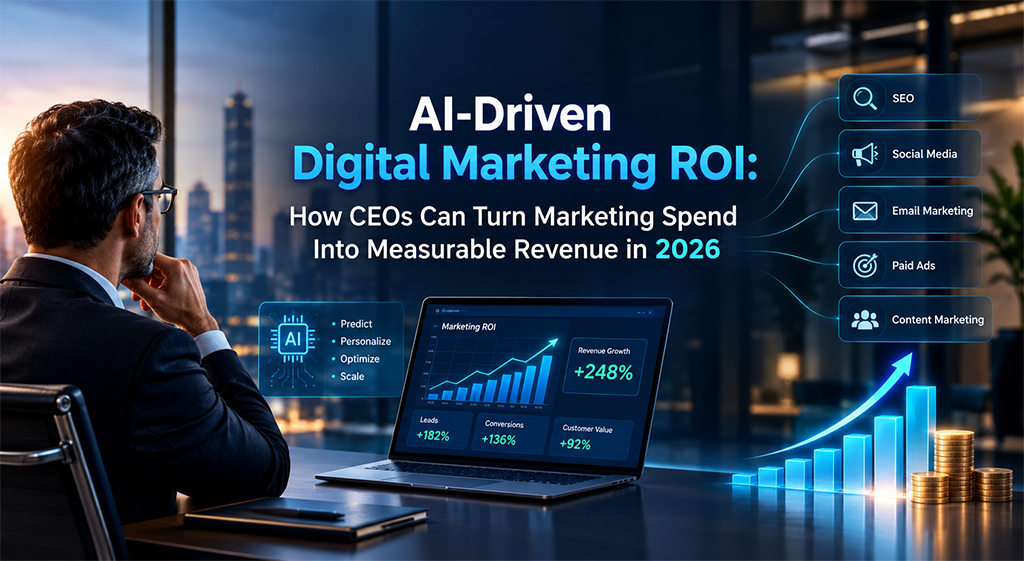
Marketing budgets are under greater scrutiny because CEOs are no longer satisfied with reports showing impressions, clicks, followers or traffic. Instead, AI-driven digital marketing ROI is helping executive teams connect marketing performance with actual business outcomes. The question at the executive level is much more direct: How much revenue did marketing generate from the money we invested?
That question is becoming harder to answer as customer journeys become more complex. A prospect may discover a company through Google, interact with an AI-generated search result, visit LinkedIn, read a blog, return through paid advertising and finally speak with sales weeks later. Consequently, traditional last-click reporting can make profitable channels look weak while giving too much credit to the final interaction.
AI-driven digital marketing is changing this equation. Instead of simply automating content creation or advertising tasks, modern AI systems can connect customer data, campaign performance, intent signals, conversion behaviour and revenue outcomes. As a result, CEOs can move from marketing activity measurement to revenue measurement.
According to HubSpot’s 2025 research involving more than 1,000 marketing and advertising professionals, 66% of marketers globally were using AI in their roles. Furthermore, 91% of marketing leaders reported that employees or teams in their organizations were using AI to assist with their work. For CEOs, however, adoption alone is not the objective. The real opportunity is using AI to determine which marketing investments create business value and which ones simply consume budget.
Why CEOs Are Struggling to Measure Digital Marketing ROI
The biggest marketing problem for many companies is not a lack of data. Instead, it is the lack of a reliable connection between marketing activity and business revenue. A marketing dashboard may show that a campaign generated 100,000 impressions and 4,000 clicks. However, those numbers do not explain whether the campaign generated qualified opportunities, customers or profitable revenue.
This becomes especially difficult for B2B businesses with long sales cycles. A CEO may approve a campaign in January, while the resulting customer signs a contract in March or April. If marketing and sales data are not connected, the campaign may appear unsuccessful even though it generated significant pipeline.
At the same time, companies often measure channels independently. Paid advertising sits in one dashboard, organic search in another, social media in another and CRM data somewhere else. Consequently, leadership receives fragmented information instead of a unified revenue picture. The solution is to build a marketing measurement framework around business outcomes rather than channel activity.
How AI Changes Digital Marketing ROI Measurement
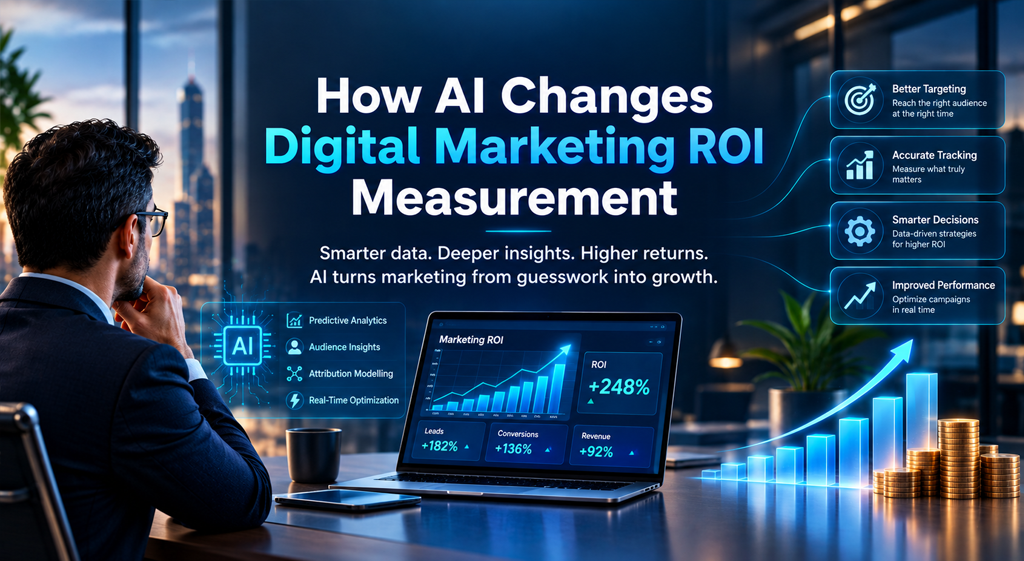
AI makes marketing ROI more actionable because it can analyze large volumes of structured and unstructured data much faster than traditional reporting systems. For example, an AI-driven marketing system can evaluate campaign costs, audience characteristics, landing-page behaviour, lead quality, CRM activity, conversion rates and historical sales outcomes. It can then identify patterns that would be difficult to detect manually. A practical AI marketing ROI model can be represented as:
Marketing ROI = (Marketing-Attributed Revenue − Marketing Investment) ÷ Marketing Investment × 100
However, sophisticated organizations should go further. Revenue attribution should also consider customer acquisition cost, customer lifetime value, sales-cycle duration, gross margin and channel-assisted conversions. Therefore, the objective is not simply to ask which campaign received the last click. Instead, CEOs should ask which combination of marketing activities contributed to profitable customer acquisition.
AI-Powered Attribution Can Reveal Where Revenue Is Actually Coming From
Attribution is one of the most important areas where AI can improve marketing decisions. Traditional attribution models often assign revenue to a single interaction. Yet a high-value B2B customer may have interacted with several touchpoints before becoming a customer. For instance, a CTO might discover a company through an organic search result, return through a technical blog, download a report, watch a product demonstration and finally submit a consultation request after seeing a LinkedIn campaign.
A last-click model may credit only the final interaction. AI-assisted attribution can instead evaluate the complete customer journey and identify patterns across multiple interactions. Consequently, CEOs can make better decisions about budget allocation. If organic search consistently contributes to high-value opportunities while paid campaigns primarily generate low-quality traffic, the company can adjust investment accordingly.
The goal is not to eliminate any particular channel. Rather, it is to understand the role each channel plays in generating revenue.
Predictive Analytics Helps CEOs Allocate Marketing Budget Before Revenue Happens
Historical reporting tells leadership what happened. Predictive analytics can help determine what is likely to happen next. AI models can analyze previous campaign performance, customer behaviour, seasonality, lead quality and conversion patterns to estimate the probability of future outcomes. For example, suppose an organization has several thousand leads in its CRM. Instead of treating every lead equally, an AI scoring model can identify prospects that demonstrate stronger buying intent.
A simplified predictive scoring approach could evaluate:
Lead Score = Behavioural Intent + Firmographic Fit + Engagement Quality + Historical Conversion Probability
The exact model should be trained using the organization’s own data rather than relying on generic assumptions. This distinction is critical. AI does not automatically create better marketing decisions simply because it is present. The quality of the data, model design, business rules and human oversight determines whether the system produces useful recommendations.
Salesforce’s latest State of Marketing research also highlights this challenge: marketers are increasingly using predictive and generative AI, while real-time data remains difficult for many organizations to activate effectively.
AI Can Reduce Marketing Waste Without Sacrificing Growth
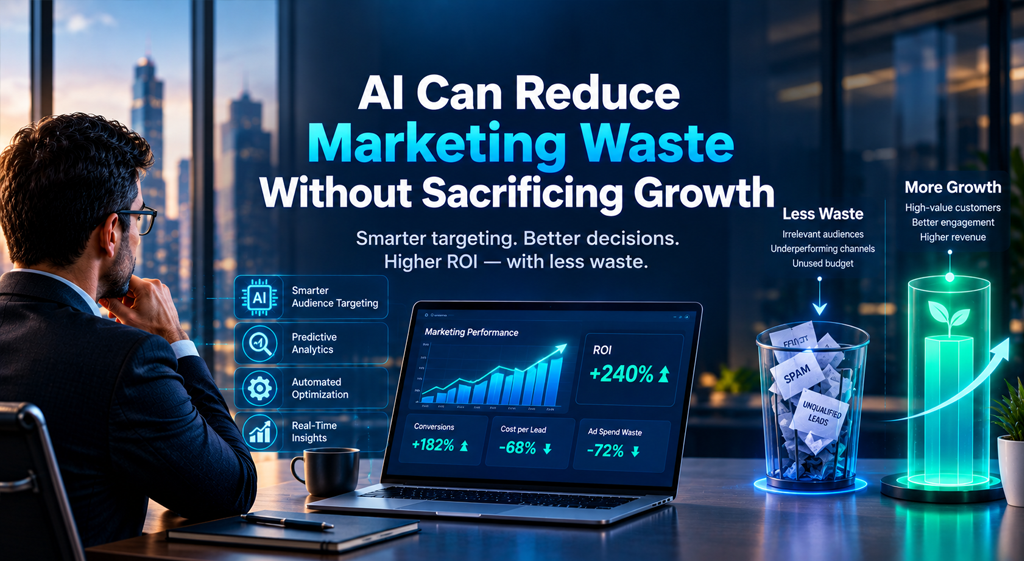
Marketing waste often happens quietly. A company may continue spending on keywords that generate traffic but few qualified leads. It may repeatedly target audiences that rarely convert. It may produce dozens of content assets without understanding which topics influence pipeline.
AI can continuously identify these patterns. For example, an optimization model can compare campaign cost against qualified-lead rate, opportunity rate and revenue contribution. When a campaign’s cost per qualified opportunity rises beyond an acceptable threshold, the system can flag the problem for human review.
Similarly, AI can identify underperforming landing pages by comparing visitor intent, engagement behaviour and conversion patterns. This creates a continuous optimization cycle:
Data → AI Analysis → Business Insight → Marketing Action → Revenue Measurement → Model Improvement
That cycle is more valuable than simply adding another AI writing tool to the marketing department.
Personalization Can Improve Conversion Without Creating More Manual Work
Another major opportunity is personalization. Customers increasingly expect businesses to understand their specific needs. However, manually creating different experiences for every segment can become expensive. AI allows companies to personalize marketing experiences using customer intent, industry, previous interactions and stage in the buying journey.
A fintech CEO, for example, should not necessarily receive the same message as a healthcare CTO. The underlying technology may be similar, but their business risks, compliance requirements, buying triggers and priorities can be completely different. AI can help identify these differences and dynamically support more relevant content, messaging and follow-up.
The result is not simply higher engagement. When implemented correctly, personalization can move prospects closer to meaningful commercial actions such as consultation requests, product demonstrations and sales conversations.
CEOs Should Measure Revenue, Not Vanity Metrics
Clicks and impressions are useful, but they should not become the final definition of marketing success. A CEO needs a hierarchy of metrics that connects marketing activity with financial outcomes. At the top should be revenue and gross-profit contribution. Below that should be qualified pipeline, opportunities, customer acquisition cost, conversion rate and customer lifetime value. Traffic, impressions and engagement should support this framework rather than dominate it.
This distinction changes the conversation inside the boardroom. Instead of saying, “Our campaign generated 500,000 impressions,” the marketing team can say, “This campaign influenced $X in qualified pipeline and generated Y customers at a CAC of $Z.” That is the language of business growth.
AI Marketing ROI Requires Human Expertise, Not Full Automation
There is a temptation to believe that AI can completely replace marketing decision-making. In practice, that approach creates new risks. HubSpot’s research found that only 4% of surveyed marketers were using generative AI to write entire pieces of content for them, while many more were using it for research, quality assurance, ideation and content support.
That distinction matters because effective marketing depends on context. AI can identify patterns, predict behaviour and accelerate execution. However, experienced marketing and business leaders still need to determine whether an insight makes strategic sense. For Edgeyon, this is particularly relevant when working with complex B2B sectors such as fintech, healthcare and technology. A technically correct campaign can still fail if it does not address regulatory concerns, purchasing behaviour, executive priorities or the actual business problem. Therefore, the strongest model is AI-assisted decision-making with human strategic oversight.
How CEOs Can Build an AI-Driven Marketing ROI Framework
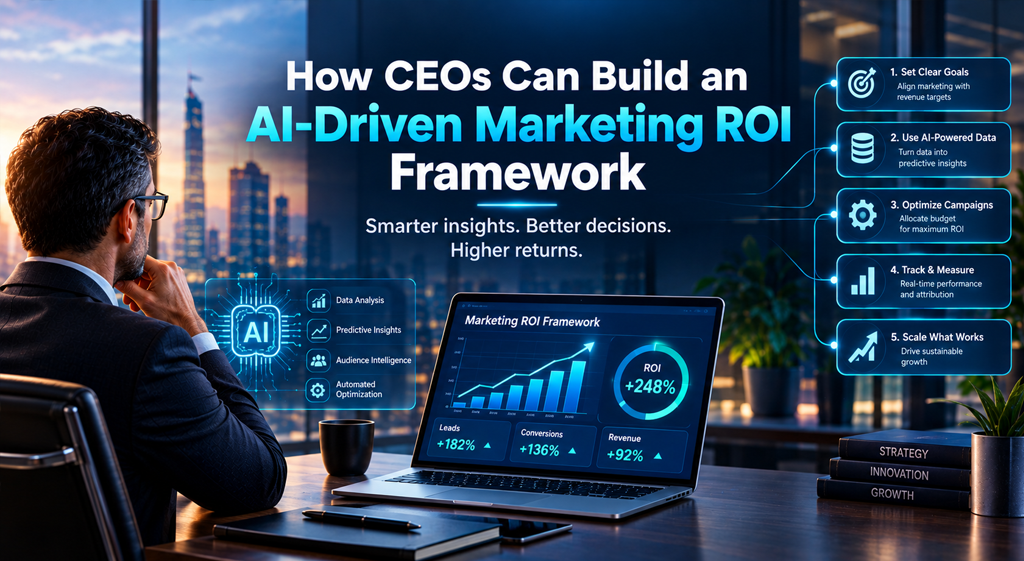
The first step is to connect marketing platforms with the CRM and revenue system. Without reliable data connections, AI will only produce sophisticated analysis of incomplete information. Next, the company should define the revenue events that matter. Depending on the business model, these may include qualified leads, opportunities, contracts, subscriptions, renewals or customer lifetime value.
After that, the organization can introduce AI-assisted attribution and predictive scoring. Historical customer data can be used to identify the characteristics and behaviours associated with successful conversions. The next stage is continuous optimization. Campaign performance should be evaluated against business outcomes rather than isolated channel metrics.
Finally, executives should establish a recurring revenue review in which marketing, sales and leadership examine the same data. This removes the common situation where marketing reports leads while sales reports revenue and neither team can confidently explain the relationship.
What CEOs Should Ask Their Marketing Team in 2026
A useful executive question is not simply, “How much did we spend?” Instead, ask: “What revenue did that investment create, which customers did it influence, and what evidence supports the attribution?” The next question should be: “Where are we wasting budget, and what does the data tell us about fixing it?” Finally, ask: “If we increased the marketing budget by 20%, which channels and customer segments would AI predict as the highest-value opportunities?” These questions shift marketing from a cost centre conversation toward a measurable growth conversation.
Why AI Search Visibility Now Matters to Marketing ROI
Marketing ROI measurement is also changing because customers increasingly use AI-powered search experiences to research companies, technologies and solutions. Google states that AI Overviews and AI Mode rely on the same foundational SEO principles used in traditional Search. Google specifically recommends people-first content, strong technical accessibility, internal linking, textual content and structured data that accurately represents visible page content.
Therefore, companies should not create separate “AI content” simply to target AI search engines. Instead, they should create authoritative pages that answer real customer questions clearly and comprehensively. For CEOs, this creates a new measurement opportunity. Organic visibility should increasingly be evaluated through qualified traffic, branded demand, assisted conversions and revenue influence rather than rankings alone.
How Edgeyon Can Help Turn Marketing Data Into Revenue Intelligence
Edgeyon Technologies combines digital marketing, AI and technology consulting to help organizations build more measurable digital growth systems. Rather than treating SEO, paid marketing, automation, analytics and technology as disconnected services, the stronger approach is to connect them around a measurable business objective.
For a company struggling with high acquisition costs, the priority may be identifying wasted advertising spend. For a B2B technology company, it may be improving lead qualification and attribution. For a fintech business, it may be combining content, search visibility, conversion optimization and automation to generate higher-value opportunities. The right strategy depends on the company’s existing data, customer journey, technology stack and commercial objectives.
If your marketing team can report traffic but cannot confidently explain how marketing investment becomes revenue, it is time to redesign the measurement framework.
Download the AI Marketing ROI Assessment Framework
Executives can begin by reviewing their current customer journey, campaign attribution, CRM data, conversion funnel and marketing costs. Edgeyon can also help businesses evaluate where AI automation, predictive analytics, SEO, conversion optimization and marketing technology can produce the greatest commercial impact.
Request an AI Marketing ROI Assessment from Edgeyon Technologies and identify where your current marketing budget is creating revenue, where it is leaking, and where AI can improve performance.
Frequently Asked Questions About AI-Driven Digital Marketing ROI
What is AI-driven digital marketing ROI?
AI-driven digital marketing ROI measures the financial return generated from marketing investments while using AI to analyze attribution, customer behaviour, campaign performance, lead quality and revenue data. It provides a more complete view than measuring clicks, impressions or traffic alone.
How can AI improve marketing ROI?
AI can improve marketing ROI by identifying high-value audiences, predicting conversion probability, optimizing campaign allocation, personalizing customer experiences, detecting inefficient spending and connecting marketing interactions with revenue outcomes.
What should CEOs measure for digital marketing ROI in 2026?
CEOs should prioritize revenue contribution, qualified pipeline, customer acquisition cost, conversion rate, customer lifetime value, marketing-influenced opportunities and profitability. Traffic and engagement remain useful, but they should support revenue-focused metrics rather than replace them.
Does AI-generated content improve SEO?
AI-generated content does not automatically improve SEO. Google states that its systems prioritize helpful, reliable, people-first content and that the quality and usefulness of the content matter more than whether AI was involved in its production.
How can companies improve visibility in Google AI Overviews?
The same foundational SEO principles remain important for Google’s AI search features. Pages should be indexable, useful, authoritative, technically accessible and supported by clear textual content and appropriate internal links. Google explicitly states that there are no additional special technical requirements or special schema required specifically for AI Overviews or AI Mode.
What schema should be used for this article?
For an article such as this, BlogPosting or Article structured data can help Google understand the content, author and publication information. Google recommends providing accurate author information, including an author URL or other identifying information where appropriate.
However, structured data does not guarantee a rich result. Google also requires structured data to accurately represent visible page content and follow its quality guidelines.
Conclusion: Marketing ROI Must Become a Revenue Conversation
AI-driven digital marketing is not about adding more automation to an already complicated marketing stack. The larger opportunity is to connect marketing investment with measurable business outcomes. When customer data, campaign intelligence, attribution, predictive analytics, CRM information and conversion data work together, CEOs gain a clearer picture of where growth is actually coming from. More importantly, leadership can stop asking whether marketing is “working” and start asking a much more valuable question:
“Which marketing investments are generating profitable revenue, and how can we scale them?”
That is the real purpose of AI-driven marketing ROI in 2026.