A marketing campaign can generate thousands of clicks and still fail to produce meaningful business growth. That is the problem many companies face when digital marketing is measured primarily through impressions, traffic, likes, followers, and click-through rates. These metrics can show that people are paying attention, but they do not always show whether marketing is creating qualified leads, sales opportunities, customers, or revenue.
A revenue-driven digital marketing strategy changes the question. Instead of asking, “How much traffic did we generate?”, business leaders can ask, “How much qualified revenue did marketing influence?” That shift is becoming increasingly important as businesses adopt artificial intelligence, automation, first-party data, predictive analytics, and increasingly sophisticated customer journeys. HubSpot’s latest research reports that 64.5% of marketers say their organizations use AI moderately or extensively, while many still struggle with implementation and measurement.
Therefore, the objective is not simply to generate more clicks. It is to build a measurable path from search visibility to engagement, leads, sales conversations, customers, and revenue.
What Is a Revenue-Driven Digital Marketing Strategy?
A revenue-driven digital marketing strategy connects marketing activity directly to business outcomes. Instead of treating SEO, paid advertising, social media, email marketing, content marketing, and conversion optimization as separate activities, the strategy connects them around one commercial objective: generating profitable customer growth.
For example, imagine a B2B technology company receives 20,000 website visits every month. At first glance, that number may look impressive. However, if those visitors rarely request consultations, download useful resources, enter the sales pipeline, or become customers, the traffic alone has limited business value.
Now consider a different scenario. The company receives only 8,000 monthly visitors, but those visitors are actively searching for its services. The website converts qualified visitors into leads, sales teams follow up quickly, and marketing can attribute a measurable portion of closed revenue to specific campaigns.
The second model is much closer to revenue-driven marketing because the entire customer journey is being measured. Google’s guidance reinforces this principle by emphasizing helpful, reliable, people-first content rather than content created primarily to manipulate search rankings.

Why Clicks Alone Are No Longer Enough
Clicks are useful because they indicate interest. However, they are only one step in the customer journey. A company can increase clicks through an attractive headline, trending topic, or high-ranking informational keyword without attracting the right buyers. Consequently, traffic can increase while sales remain unchanged.
This creates a common business problem: marketing reports look positive, but management cannot clearly connect those numbers to revenue. The solution is to create a measurement framework that follows the customer beyond the first click.
A revenue-focused funnel should connect visibility → qualified traffic → engagement → conversion → qualified lead → sales opportunity → customer → revenue. Once these stages are connected, businesses can identify where money is being created and where potential customers are being lost.
Start With Revenue Goals, Not Marketing Channels
One of the biggest mistakes companies make is choosing marketing channels before defining the commercial objective. For example, a business might decide to “do SEO,” “run Google Ads,” or “increase social media engagement.” However, these are activities, not business outcomes.
A stronger approach begins with questions such as:
What revenue target does marketing need to influence? How many new customers are required to achieve that target? What is the average customer value? How many qualified opportunities are required to generate those customers? What conversion rate is realistic at each stage? Once these numbers are understood, marketing channels can be selected based on their ability to support the revenue objective.
For instance, a high-value B2B service may require fewer but more qualified leads. In contrast, an e-commerce company may require a much larger volume of transactions. Therefore, the same digital marketing strategy should not be applied identically to every business.
Build Content Around Commercial Search Intent
Content remains an important part of digital marketing, but the focus needs to move beyond producing articles simply because a keyword has search volume. Revenue-driven content begins with search intent.
Someone searching “what is digital marketing?” may still be researching. Meanwhile, someone searching “digital marketing agency for fintech company” is demonstrating a substantially different commercial intent. Therefore, businesses should create content across the customer journey.
Educational content can help potential customers understand a problem. Comparison content can help them evaluate alternatives. Solution-focused pages can explain how the business solves that problem. Case studies can provide evidence. Finally, service and consultation pages can turn purchase-ready visitors into leads. This creates a connected content ecosystem rather than a collection of unrelated blog posts.
Google’s current guidance for AI Search also emphasizes unique, valuable content that satisfies people rather than attempting to create content specifically for an algorithm.

Turn Website Traffic Into Qualified Leads
Getting visitors to a website is only half the job. The next challenge is giving the right visitor a compelling reason to take the next step. A weak conversion path might simply place a generic “Contact Us” button at the bottom of every page. Although that can work, it does not always address the visitor’s immediate concern.
A stronger approach matches the conversion opportunity to the user’s intent. For example, a visitor researching fintech transformation may respond better to a downloadable FinTech Digital Transformation Checklist, while a business actively evaluating service providers may be more interested in a consultation, project assessment, technical audit, or implementation roadmap.
Consequently, lead magnets should solve a real problem rather than simply collect email addresses. For Edgeyon, for example, a revenue-focused content journey could connect educational articles about fintech technology, AI automation, blockchain, cybersecurity, or digital transformation with relevant service pages and consultation CTAs.
Use AI for Intelligence, Not Just Content Creation
AI can make digital marketing faster, but speed alone does not guarantee revenue. Current marketing research shows that AI adoption is widespread. HubSpot reports that 98% of surveyed marketing teams use AI in some form, while its research also highlights that measurable AI outcomes increasingly come from applying data and business context rather than simply producing more content.
Therefore, businesses should use AI across the decision-making process. An AI-supported marketing system can analyze search behavior, identify high-intent audiences, segment customers, detect unusual conversion patterns, predict potential customer value, personalize messaging, identify content gaps, and help marketing teams prioritize opportunities.
For example, if a company’s analytics show that visitors from a particular industry repeatedly visit a specific service page but rarely submit a form, AI-assisted analysis can help identify patterns in the journey. The marketing team can then test different messaging, proof points, CTAs, page structures, or lead magnets. The important distinction is that AI should support human decision-making rather than replace strategic judgment.
Connect Marketing Data With Sales Data
Revenue attribution becomes difficult when marketing and sales operate with disconnected data. Marketing may report leads. Sales may report opportunities. Finance may report revenue. However, if these systems cannot be connected, nobody has a complete picture of the customer journey. A revenue-driven strategy therefore requires alignment between marketing, CRM, sales, analytics, and finance.
Consider a lead generated through an organic search article. If that visitor later books a consultation, enters the CRM, becomes an opportunity, and eventually becomes a customer, the organization should be able to connect those stages. This makes it possible to identify which campaigns generate not merely leads, but commercially valuable opportunities. It also helps management make better budget decisions because marketing investment can be evaluated against actual business outcomes.
Optimize for Conversion Before Simply Increasing Traffic
Increasing traffic is not always the fastest way to improve marketing performance. Sometimes the bigger opportunity already exists within the traffic a company receives. Suppose a website receives 10,000 monthly visitors but converts only 0.5% into leads. Improving the customer journey, messaging, trust signals, page experience, and CTA structure can potentially create substantial additional lead volume without requiring the business to double traffic.
That is why conversion rate optimization should be treated as an ongoing business process. The team should examine where users hesitate, which pages generate commercial engagement, where forms are abandoned, which CTAs receive meaningful engagement, and which landing pages contribute to qualified opportunities. Then, instead of guessing, businesses can test improvements and measure the resulting impact.
Build Trust Before Asking for the Sale
A visitor rarely becomes a customer simply because a company claims to be an expert. Trust has to be demonstrated. That is where E-E-A-T becomes particularly valuable. Google describes E-E-A-T as experience, expertise, authoritativeness, and trustworthiness, while noting that E-E-A-T itself is not a specific ranking factor. Google also recommends making it clear who created content and providing appropriate authorship information.
For a business website, this means demonstrating real-world knowledge through original insights, practical examples, case studies, author information, service expertise, transparent company information, credible references, and evidence of actual experience. Instead of writing, “We deliver world-class digital transformation,” a stronger page can explain the business problem, implementation approach, technology considerations, risks, measurable outcomes, and lessons learned. That gives potential customers something they can evaluate.
Measure the Metrics That Actually Matter
A revenue-driven strategy does not mean abandoning traffic metrics. Instead, it means putting them into business context. Organic traffic can indicate visibility. Engagement can indicate relevance. Conversion rate can indicate whether the website is persuading visitors to act. Marketing-qualified leads can indicate potential commercial value.
Sales-qualified opportunities can indicate stronger buying intent. Customer acquisition cost can indicate efficiency. Customer lifetime value can indicate long-term economic value. Marketing-attributed revenue can connect campaigns to actual business outcomes. The key is to avoid treating one metric as the complete picture. For example, a campaign with a lower number of leads could still be commercially stronger if those leads have substantially higher conversion rates and customer value.
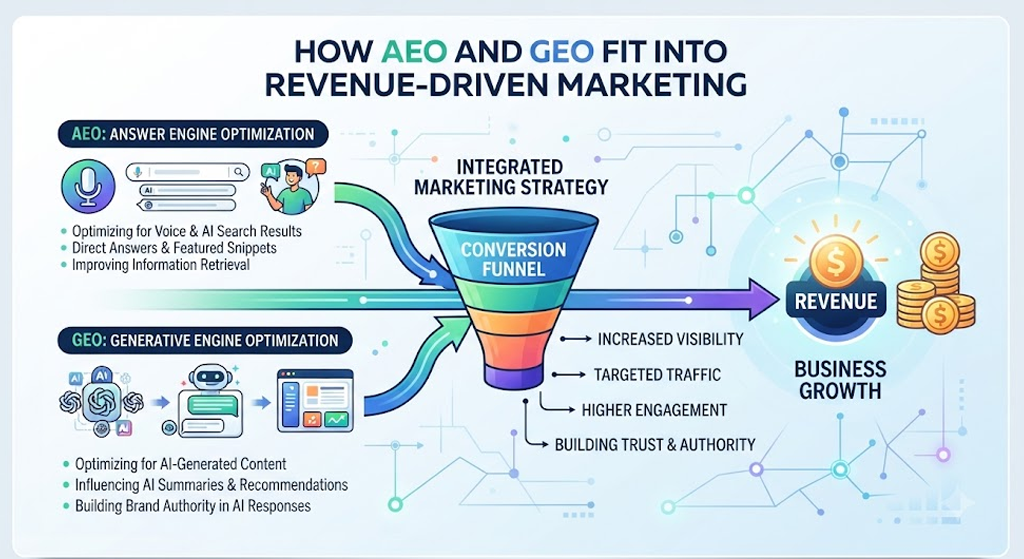
How AEO and GEO Fit Into Revenue-Driven Marketing
Search behavior is changing as users increasingly interact with AI-powered search experiences. However, businesses should not treat AEO or GEO as a completely separate replacement for SEO. Google’s current documentation states that the same fundamental SEO practices remain relevant for AI Overviews and AI Mode, and that there are no special requirements that guarantee inclusion in AI features.
Therefore, the practical strategy is to create content that answers real questions clearly and comprehensively. Use descriptive headings, direct answers, meaningful supporting explanations, relevant entities, original insights, structured information, strong internal linking, and trustworthy sources. For example, a section answering “What is a revenue-driven digital marketing strategy?” should provide a concise definition before expanding into the details. That structure helps users, traditional search systems, and AI-driven search experiences understand the page.
Create a Digital Marketing Strategy That Learns From Every Customer
A successful revenue-driven digital marketing strategy should not remain static. Customer behavior changes. Search behavior changes. Competitors change. Advertising costs change. AI capabilities change. Therefore, marketing systems need continuous measurement and refinement. The most valuable feedback does not always come from a dashboard.
Sales teams can reveal which objections prospects repeatedly raise. Customer support can reveal recurring problems. Search data can reveal emerging questions. CRM data can reveal which lead sources produce customers. Website analytics can reveal where visitors leave. When these insights are brought together, marketing becomes less about producing more campaigns and more about improving the entire customer acquisition system.
Frequently Asked Questions About Revenue-Driven Digital Marketing
What is a revenue-driven digital marketing strategy?
A revenue-driven digital marketing strategy connects marketing activities to measurable business outcomes such as qualified leads, sales opportunities, customer acquisition, and revenue. Instead of measuring success primarily through clicks or impressions, it evaluates how marketing contributes to commercial growth.
How can businesses turn website traffic into customers?
Businesses can improve the path from traffic to customers by targeting high-intent audiences, creating content that matches search intent, strengthening landing pages, providing relevant lead magnets, using clear CTAs, improving follow-up processes, and connecting marketing data with CRM and sales data.
How does AI improve digital marketing ROI?
AI can analyze customer behavior, identify patterns, segment audiences, support personalization, automate repetitive workflows, predict potential opportunities, and assist with performance analysis. However, AI works best when combined with reliable business data, human expertise, and clearly defined commercial objectives.
Is SEO still important for AEO and GEO?
Yes. Google states that foundational SEO practices remain relevant for its AI Search experiences, including AI Overviews and AI Mode. Businesses should therefore focus on technically accessible websites and useful, original, trustworthy content rather than trying to manipulate AI systems with special optimization tricks.
What should businesses measure in revenue-driven marketing?
Businesses should connect marketing metrics with commercial outcomes. Depending on the business model, important measures can include qualified leads, conversion rates, sales opportunities, customer acquisition cost, customer lifetime value, pipeline contribution, and marketing-attributed revenue.
Stop Measuring Marketing by Clicks Alone
Clicks tell you that someone arrived. Revenue tells you whether the journey created business value. That difference should shape the way companies approach digital marketing in 2026. The goal is not simply to publish more content, attract more visitors, or generate larger engagement numbers. Instead, the goal is to create a connected system in which the right audience discovers the business, understands its value, trusts its expertise, takes action, and ultimately becomes a customer.
For businesses struggling with rising acquisition costs, disconnected marketing data, low-quality leads, or traffic that does not translate into sales, the answer may not be another campaign. It may be a better revenue strategy.
Ready to turn digital marketing into a measurable growth engine? Edgeyon Technologies can help businesses connect digital strategy, AI, automation, technology, SEO, and conversion-focused experiences around measurable business objectives.
Request a Digital Marketing & Revenue Growth Consultation.
Get the Revenue-Driven Digital Marketing Strategy Checklist for 2026 to identify gaps across traffic, conversion, lead generation, analytics, AI, and customer acquisition.